The Coast Salish Baby Blanket Project
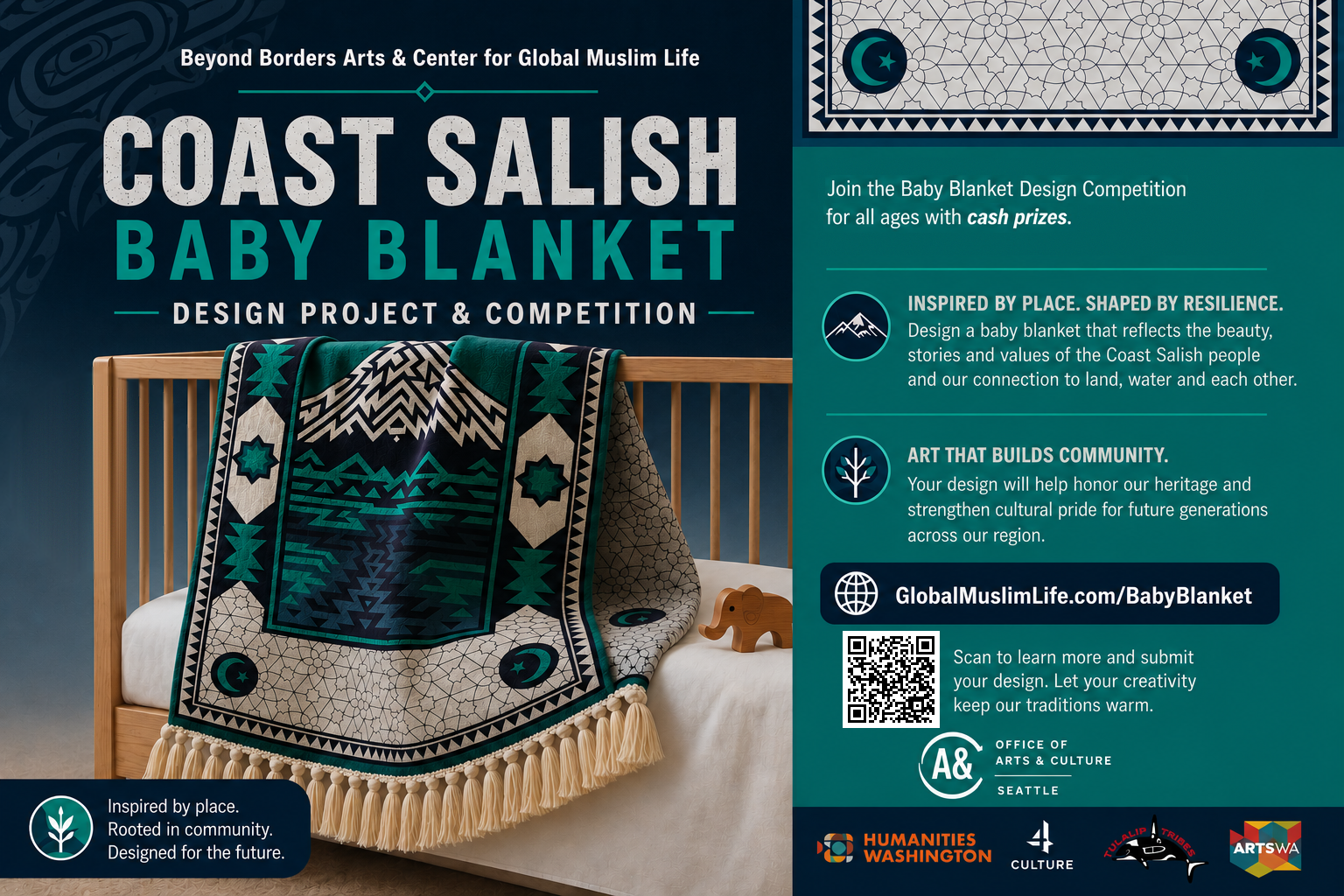
The Coast Salish Baby Blanket Project
Building Monuments of Belonging
What does it mean for a child to belong here?
The Baby Blanket Project is a community design project of Beyond Borders Arts and the Center for Global Muslim Life. Indigenous, Muslim, Black, Latino, Asian, refugee, immigrant, and working-class families come together to share their stories of land, arrival, and welcome. Together with artists, we design blankets that hold what it means for our children to belong here.
Monuments of Belonging
A monument does not have to be bronze or stone to matter. It can be something a family holds.
Nearly every family, of every faith and background, has a way of welcoming a new child. A blanket is one of the first things a child is wrapped in. It is where a family's hopes, prayers, and memory of where they come from are first placed around a new life.
A blanket that carries a community's stories, designed together and given back to the families who shaped it, is a monument that travels into homes and gets passed down. It says to a child: you were expected, you were prayed for, and you belong to a people and a place.
Monuments of Belonging asks a question every family can answer. What do we want our children to know about where they belong?
Where this began: the Prayer Rug Project
The Baby Blanket Project grows directly out of our Pacific Northwest Prayer Rug Project. Over two years, Coast Salish and Muslim artists came into sustained co-creation through shared land-based cosmology and Islamic sacred geometry. The Salish Sea Prayer Rug was designed by Josue Vega, with artistic direction by Mustafa Dustin Craun and Claudia Craun, and developed through a series of community workshops with a design team based in King County.
Indigenous and Muslim artists worked across distinct traditions without having to surrender the histories that made those traditions meaningful. The prayer rug taught us three things.
First, shared work across communities takes time. Artists need space to build trust, learn the histories they are entering, and work through questions of authorship, land, memory, and responsibility before a design is ready for public view.
Second, shared work does not require treating all communities as the same. A relationship to land does not mean the same thing for a sovereign Indigenous nation and a displaced diasporic community.
Third, an object made together can become a monument. It can carry a community's memory, mark who belongs, and pass from one generation to the next.
The prayer rug was our first monument of belonging. The baby blanket is the next.
Opening the circle
A prayer rug speaks most directly to Muslim communities. A baby blanket speaks to everyone.
With the prayer rugs complete, the Baby Blanket Project carries the same design practice beyond the Muslim community. We are building with Indigenous, Black, Latino, Asian, Muslim, refugee, and immigrant families, and with the early childhood centers, schools, and community organizations that already serve them.
We begin in South Seattle and South King County. Our region is full of people who live between worlds: families who carry one homeland while raising children in another, on land that has been home to Coast Salish peoples since time immemorial. Neighbors from these communities often live side by side without ever being in a room together.
From here, we want to grow with partners across the Pacific Northwest and beyond, wherever communities invite us to build monuments of belonging together.
Birth is not equal
Every family deserves to welcome a child in safety and with dignity. Not every family does. In the United States and across the Western world, the dangers of giving birth fall hardest on Indigenous, Black, immigrant, refugee, and low-income families.
Here in Washington, American Indian and Alaska Native people have had the highest maternal mortality rates in every state review to date. Their risk of dying from pregnancy-related causes was 7.3 times that of white people. The state found that 82% of pregnancy-related deaths were preventable, and that people on Medicaid died at higher rates than people with private insurance. (Washington State Department of Health, 2025)
Across the country, Black women died of maternal causes in 2024 at 44.8 deaths per 100,000 live births, more than three times the rate for white women. (CDC, 2026) Babies born to Black mothers died before their first birthday at a rate of 10.98 per 1,000 births. Babies born to American Indian and Alaska Native mothers died at 9.20 per 1,000. Both are about double the rate for babies of white mothers. (CDC, 2026)
Discrimination is part of this story. In a 2023 CDC survey, one in five mothers reported mistreatment during maternity care, such as being ignored when they asked for help or being shouted at. Mistreatment was higher for Black (30%), Hispanic (29%), and multiracial (27%) women, and for women with no insurance (28%) or public insurance (26%) than for women with private insurance (16%). Around four in ten Black, multiracial, and Hispanic mothers reported discrimination. The survey was given only in English, so it leaves out many immigrant and refugee mothers entirely. (CDC, 2023)
The pattern does not stop at our borders. In the United Kingdom, Black women died at nearly three times the rate of white women from 2022 to 2024, and women in the poorest areas died at about twice the rate of women in the wealthiest. (MBRRACE-UK, 2026) A review of studies across high-income countries found that migrant women in Europe faced a higher risk of maternal death than women born there, especially women born in sub-Saharan Africa, Latin America and the Caribbean, and Asia. (PLOS Medicine, 2023)
Muslim mothers are often invisible in this data, which counts race but rarely faith. When Muslim Women's Network UK surveyed 1,022 Muslim women, one in five rated their maternity care poor or very poor. Women described staff treating them differently because of their race, faith, clothing, and accent. Some took off their headscarves to be treated better. (Muslim Women's Network UK, 2022)
A blanket will not change a hospital. The people who make it together can change what our communities expect, and who we stand beside. We are inviting birth workers, doulas, and families to shape how this project addresses unequal care, and how our workshops can support the work they are already doing. There is room here for joy and for grief. Families can celebrate a new life and, if they choose, remember mothers and children whose lives were lost. No one will be asked to tell a painful story in order to take part.
What we are building
The work begins with the Coast Salish Baby Blanket Design Project and Competition. Over the next year, we will host six community design workshops in South Seattle and South King County, reaching 100 participants: parents, grandparents, expecting families, young people, artists, and birth workers. Our first workshop is November 18, 2026 at the Inatai Foundation.
In each workshop, families meet one another and share how their traditions welcome children. Together they turn their stories of land, water, arrival, and welcome into symbols and patterns. Participants create design studies, not finished blankets. Working with Indigenous and Muslim artists, the group decides which ideas become part of a shared set of blankets, and how those blankets will be gifted, shared, and shown.
Alongside the workshops, our design competition is open to people of all ages, with cash prizes. Anyone who answers our community questions can enter a drawing to win an iPad.
The blanket itself is still in development. Workshop details, participating artists, and registration will be posted here as they are confirmed.
How we work
We develop the blankets in collaboration with Indigenous artists and community partners. The design process, cultural permissions, authorship, and compensation are agreed together, and every artist is paid for their time. We will share the names and contributions of collaborators as those partnerships are confirmed and approved for announcement.
This is Coast Salish land. Where a design draws on a particular Indigenous community's knowledge, we seek guidance from that community's artists and knowledge holders before moving forward. Cultural knowledge is not free design material. No one is asked to speak for a community they do not represent.
Families keep credit for their stories. We ask separate permission before sharing anyone's photograph, story, or design, and collective designs have clear agreements about how they are used.
Participation is free, with food, materials, and interpretation where needed, so that cost and language are not barriers.
These blankets are made to be held, gifted, displayed, and passed down. Following safe sleep guidance, they do not belong in a sleeping baby's crib.
Get involved
We are seeking workshop hosts and collaborators in the Pacific Northwest and beyond. We especially want to hear from organizations already working with Indigenous, Black, Latino, Asian, Muslim, immigrant, and refugee families, and from people who support mothers, babies, and caregivers in their own communities. We want partners to help shape the questions and the gatherings, not simply share an announcement after the decisions have been made.
If your organization would like to host a design workshop, or if you are an artist or birth worker interested in collaborating, contact dustin@globalmuslimlife.com.
Come help us build a monument every family can hold.
Sources
Maternal Mortality Rates in the United States, 2024, CDC National Center for Health Statistics, March 2026
Infant Mortality in the United States, 2024, CDC National Vital Statistics Reports, June 2026
One in 5 Women Reported Mistreatment While Receiving Maternity Care, CDC Vital Signs, August 2023
2025 Maternal Mortality Review Panel Report, Washington State Department of Health, December 2025
Saving Lives, Improving Mothers' Care 2026, MBRRACE-UK, September 2026
Association between migration and severe maternal outcomes in high-income countries, PLOS Medicine, June 2023
Invisible: Maternity Experiences of Muslim Women from Racialised Minority Communities, Muslim Women's Network UK, July 2022
Safe Sleep, U.S. Consumer Product Safety CommissionMauris id fermentum nulla. Aenean eu justo sed elit dignissim aliquam. Suspendisse nec congue purus. Nulla eu pretium massa.