The Pacific Northwest Prayer Rug Project
﷽
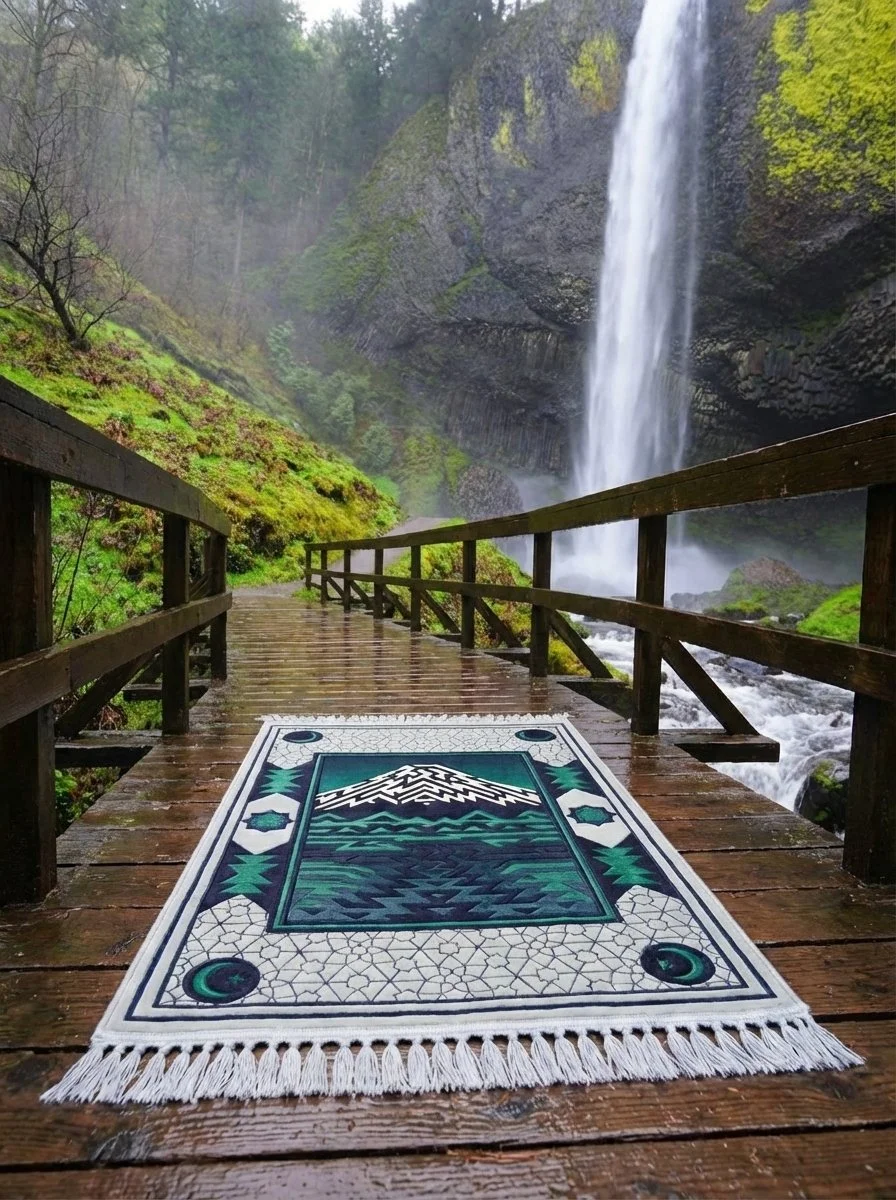
After two years of work we are honored to present to you the 2nd Turtle Island Prayer Rug - the Pacific Northwest Prayer Rug designed by Josue Vega and Mustafa Dustin Craun.
As Salaam Alaykum Mitákuye Oyás’iŋ* (Peace be upon you all my relatives) *Arabic & Lakota
Mitákuye Oyás’iŋ (Lakota), Indinawemaaganidag (Ojibwe), ʔə tiʔəʔ syaʔyaʔ (Lushootseed) that all of existence is interrelated, is a core idea within indigenous cosmologies of the Americas. For Muslims, this interrelation has to do with the divine essence, the breath that gave life to all of creation, what we would call, the Breath of the All-Merciful. This Interrelation is at the core of the first Turtle Island Prayer Rug - the Pacific Northwest prayer rug project as we attempt to explore Muslim life in the Pacific Northwest while also paying respect to whose land this is, with nearly 250 distinct tribal nations and First Nations peoples, who are the stewards of their ancestral homelands.
The PNW Prayer Rug Project, led by the Center for Global Muslim Life, is a cultural heritage and narrative-change initiative that reimagines the prayer rug as a living artifact of the sacredness of these lands we live on, the histories of our communities, ancestors who built the first Muslim communities here, and as an artifact of migration and belonging. This rug is meant to reflect the stories, identities, and ancestral ties of Muslim communities across the Pacific Northwestern part of Turtle Island, what is known today as Washington State, the state of Oregon, and the Province of British Columbia.
These identities rooted in African and African American communities who founded Islam in these lands, the Andalusian roots of early Muslims in the Americas, the indigenous communities who protected early Muslim communities, and the African American and immigrant Muslim communities who built the infrastructure of Islam in the Americas today. This rug is also part of the larger global prayer rug project which brings together Muslim and local Indigenous artists, designers, and community members to co-create regionally rooted prayer rugs and matching baby blankets throughout the Americas and around the world.
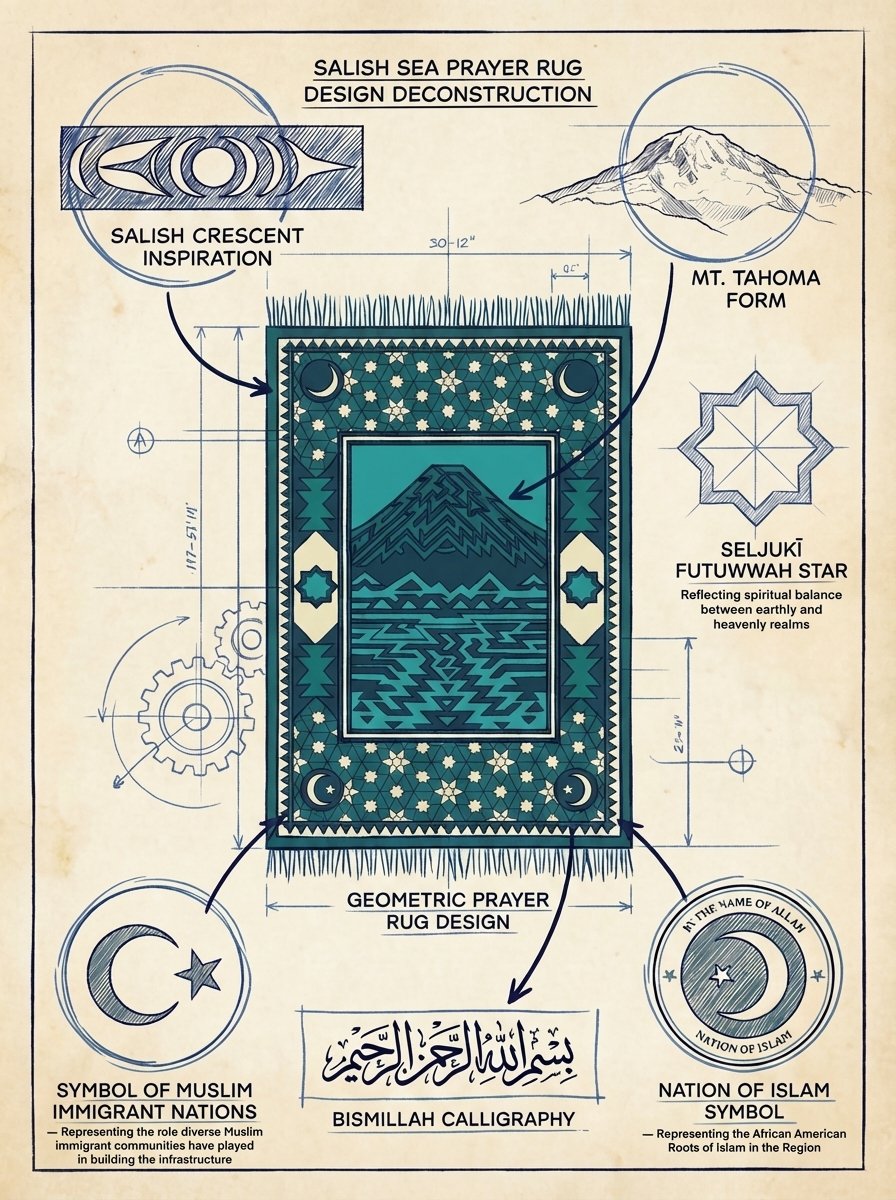
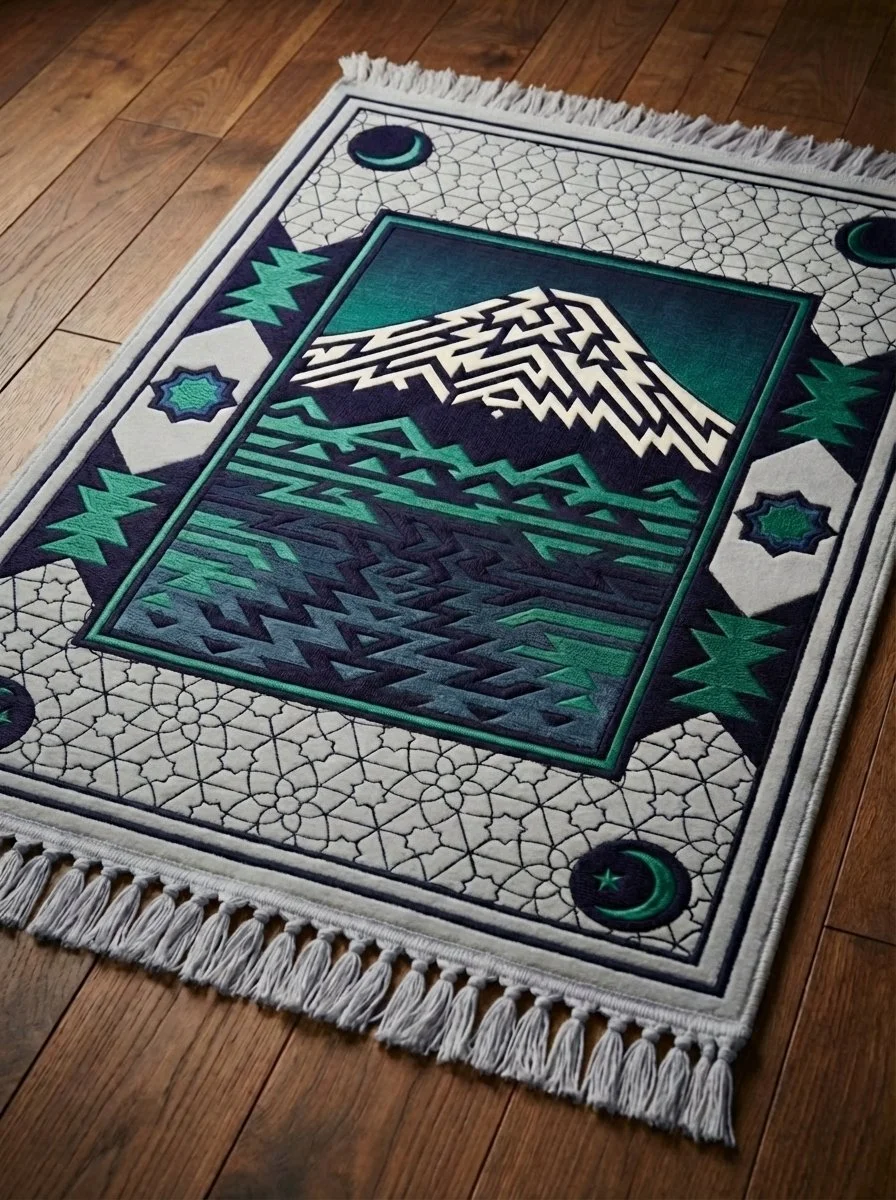
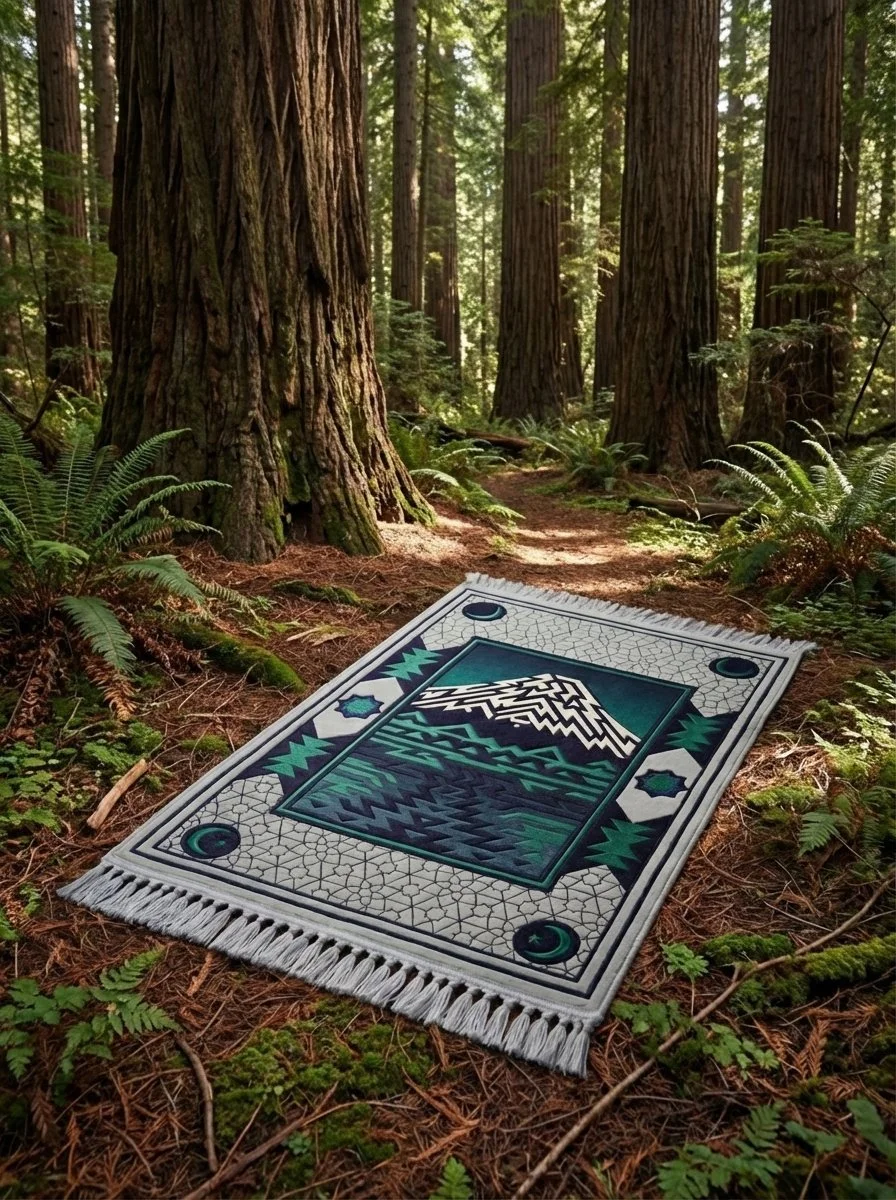
The design elements of this rug are rooted in the sacredness of place and time in showing the early hours of fajr (dawn) a time of prayer and reflection that we see in the light color of the dawn emerging on the horizon. Tahoma (Mt. Rainier) is at the center of this design what the Puyallup and Nisqually tribes call təqʷuʔməʔ (pronounced roughly "Taquoma") in the Lushootseed language meaning "the mother of all waters." The colors on the rug are reflective of the water of the Salish Sea that surrounds us, the old growth forests that give this place so much life, and the land we walk on.
Through a mixture of Islamic design, Coast Salish design inspirations, and other indigenous design inspirations tied to our prayer rug of the America's design we see the stark lines reflective of the style of our brilliant Puerto Rican Muslim American designer, Josue Vega, a classically trained Arabic calligraphy and graphic design artist. We see this octogram design what has been called alternatively the Seljukī Futuwwah star, the Rub al Hizb, and the Quds Star reflecting both design unity, and spiritual balance between earthly and heavenly realms. This design was seen throughout Andalucía and Jerusalem, but was actually first from Konya where the Seljuk's tied its meaning the the idea of Futuwwah or sacred chivalry with each point of the star meaning a different virtue - mercy and compassion, patience, truthfulness, sincerity, the keeping of secrets and respecting privacy, loyalty, generosity, and gratitude.
Finally, we see the four crescents on the rug, if we start in the bottom right corner, we see first a crescent in the style of the Nation of Islam a community that would lay the foundation for the popular propagation of Islam for the first time in the Americas. This is a community that would see Malcolm X, Muhammad Ali, and Imam Warith Deen Mohammed guide millions of people to Al Islam and lay the foundation for the Muslim community we see growing in the United States today building the first Mosques in cities across the United States including Seattle. Opposite that crescent is a crescent in the style you would see on the flags of Muslim majority countries from around the world, as post-1965 these diverse global Muslim immigrant communities have built thousands of Mosques and spread Islam throughout the United States, Canada, with a growing presence throughout the America's at large. Finally at the top of the rug we see waxing and waning crescents in the style of Coast Salish design representing the future of Islam in these lands in growing Latino, Indigenous, and mixed race populations, and beyond the borders and boundaries that have made up our identities in the past. While living as a community rooted in tradition, spiritual growth, and Prophetic examples as we work to create a better world for all people.
Amen & Ameen
P.S. Pre-Orders of the Prayer Rug should be delivered by the end of May of 2026. Some aspects of the rug may have to change in production.
Anyone who gives more than $99 to our Ramadan fundraising campaign for the Center for Global Muslim Life will receive a PWN prayer rug.